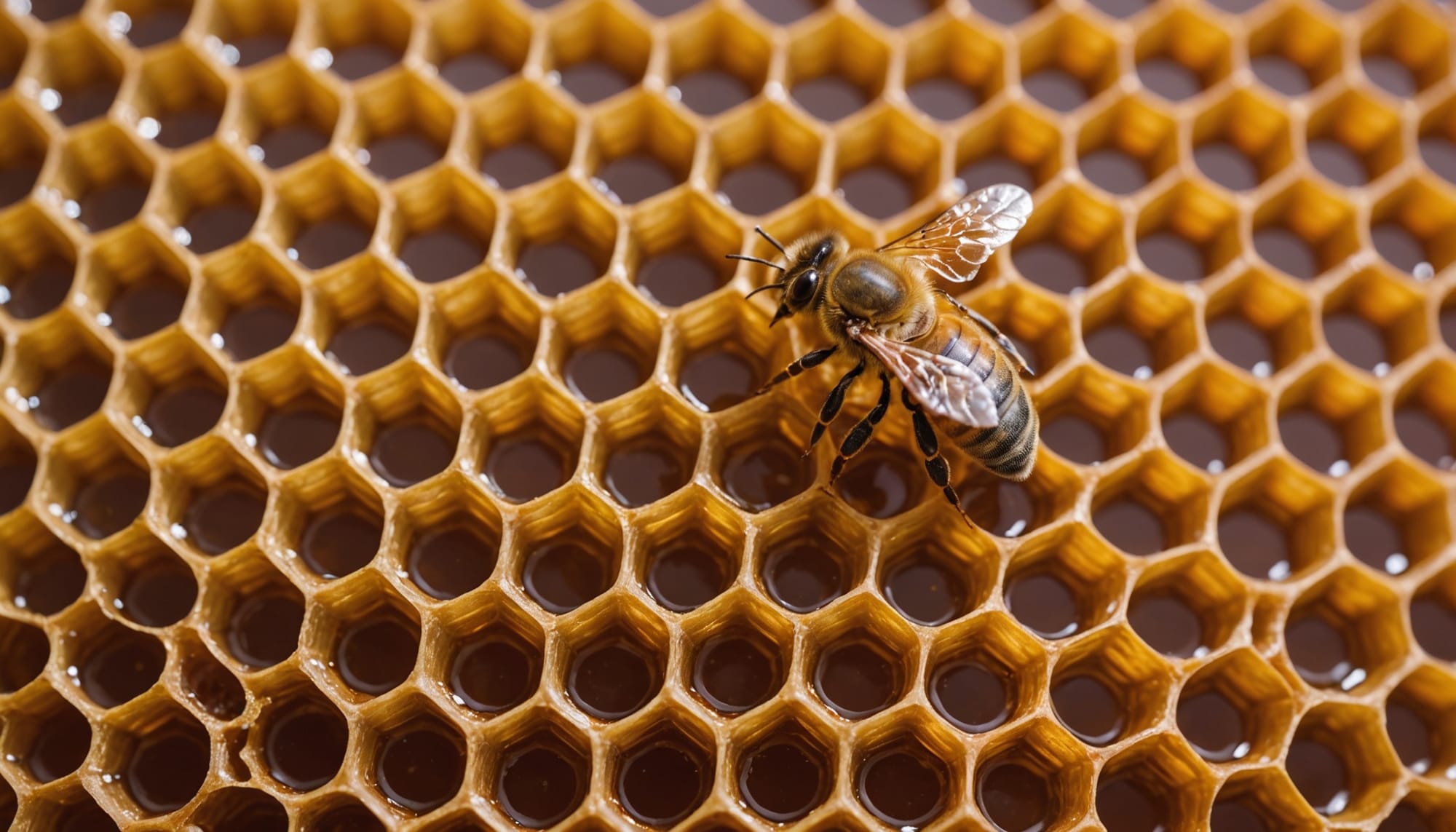
Here's a question that haunted mathematicians for centuries: if you need to divide a flat surface into equal cells using the least total perimeter, what shape should you use?
Triangles work. Squares work. But hexagons? Hexagons are perfect.
This is called the Honeycomb Conjecture, and bees have been casually demonstrating the answer for about 30 million years. The idea is simple. You want to store the most honey using the least wax. Wax is expensive — a bee must consume roughly eight ounces of honey to produce a single ounce of it. So every fraction of a millimeter matters.
Of all the regular shapes that tile a flat plane without gaps — triangles, squares, and hexagons — the hexagon has the smallest perimeter relative to its area. It's not even close. A hexagonal grid uses about 5% less material than a square grid covering the same area. Over thousands of cells, that savings is enormous.
But here's the part that should make you sit up. For most of recorded mathematical history, nobody could actually prove that hexagons were optimal. The ancient Roman scholar Varro noted the hexagonal structure of honeycomb around 36 BC. The Greek mathematician Pappus of Alexandria argued in the 4th century that bees must have "a certain geometrical forethought." Yet the rigorous proof eluded everyone.
It wasn't until 1999 that Thomas Hales, a mathematician at the University of Michigan, finally nailed it. His proof confirmed what bees already knew: among all possible ways to partition a plane into regions of equal area, the regular hexagonal grid has the least total perimeter. Full stop. No other shape — regular, irregular, curved, or otherwise — beats it.
And the bees don't even start with hexagons. They build roughly circular tubes, then warm the wax with their bodies to about 45°C. Surface tension and the physics of cooling pull those circles into hexagons naturally, the same way bubbles in a foam settle into hexagonal patterns where they meet. The bees provide the heat. Geometry does the rest.
This is what gets me. The bees aren't doing math. They're not thinking about perimeter-to-area ratios. They're following simple behavioral rules — build a tube, warm it up, pack it tight — and the mathematics emerges. The optimization is baked into the physics itself, waiting to be expressed.
It took one of the sharpest mathematical minds of the 20th century nineteen pages of proof to confirm what a insect with a brain smaller than a sesame seed had been doing all along.
Makes you wonder what other deep truths are hiding in plain sight, patiently being demonstrated by creatures that will never know how clever they are.