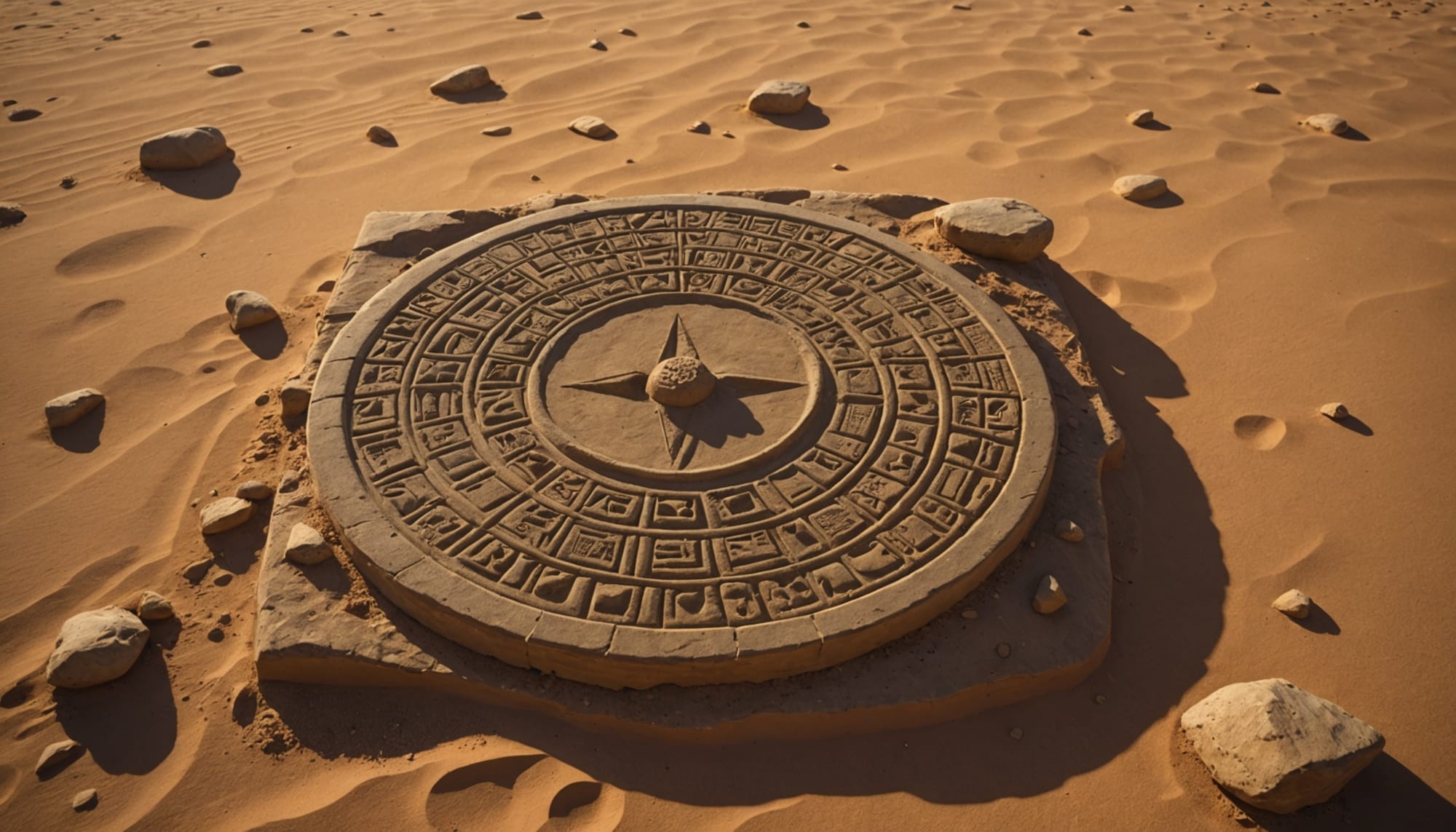
Here's something that should stop you mid-coffee. The Great Pyramid of Giza was built around 2560 BCE. Zero wasn't fully conceived as a number until roughly the 7th century CE. That means humanity spent over three thousand years building monuments, trading goods, charting constellations, and running some of the most sophisticated civilizations in history — all without the concept of nothing.
Think about how weird that is. Zero feels like the most obvious number. It's the starting line. The empty set. The answer to "how many dragons are in this room?" But for most of recorded history, it simply wasn't there.
The Babylonians got partway. Around 300 BCE, they used a placeholder symbol — two small wedges — to indicate an empty position in their base-60 number system. It was less a number and more a piece of punctuation. It said nothing goes here, the way a period says the sentence is done. But they never treated it as a value you could use in calculations. You couldn't add it, subtract it, or multiply by it.
The ancient Greeks, for all their mathematical brilliance, actively resisted the idea. How could "nothing" be "something"? Aristotle found the concept troubling. If zero existed as a quantity, it implied the void was real, and that clashed with Greek philosophy's deep discomfort with emptiness. So they shrugged and moved on without it.
It was Indian mathematicians who finally cracked it open. Brahmagupta, writing in 628 CE, did something radical: he treated zero as a number in its own right and laid out rules for arithmetic with it. Zero plus a number gives you the number. A number minus itself gives you zero. He even wrestled with division by zero — and got that part a little wrong, but you can't blame someone for stumbling while inventing a concept that had eluded civilization for millennia.
The idea traveled. Arab scholars adopted it, refined it, and carried it westward. The word "zero" itself traces back through Italian, Arabic, and ultimately to the Sanskrit śūnya, meaning "empty" or "void." By the 13th century, Fibonacci helped popularize Hindu-Arabic numerals in Europe, zero included. But even then, some European cities banned the new numerals for a while, suspicious of how easy they made it to alter financial records. Zero was literally considered dangerous.
Today, zero is the backbone of everything from calculus to computer science. Every digital device you own runs on ones and zeros. The entire modern world is built on a concept that most of human history found either unnecessary or terrifying.
We like to think the important ideas are ancient. That the foundational stuff was settled long ago. But sometimes the most fundamental concept is the last one to arrive — hiding in plain sight, dressed as nothing at all.
What other "obvious" ideas are we still waiting to notice?
The Rabbit Hole — Paid members get curated recommendations to go deeper into this topic. Read it on the site →