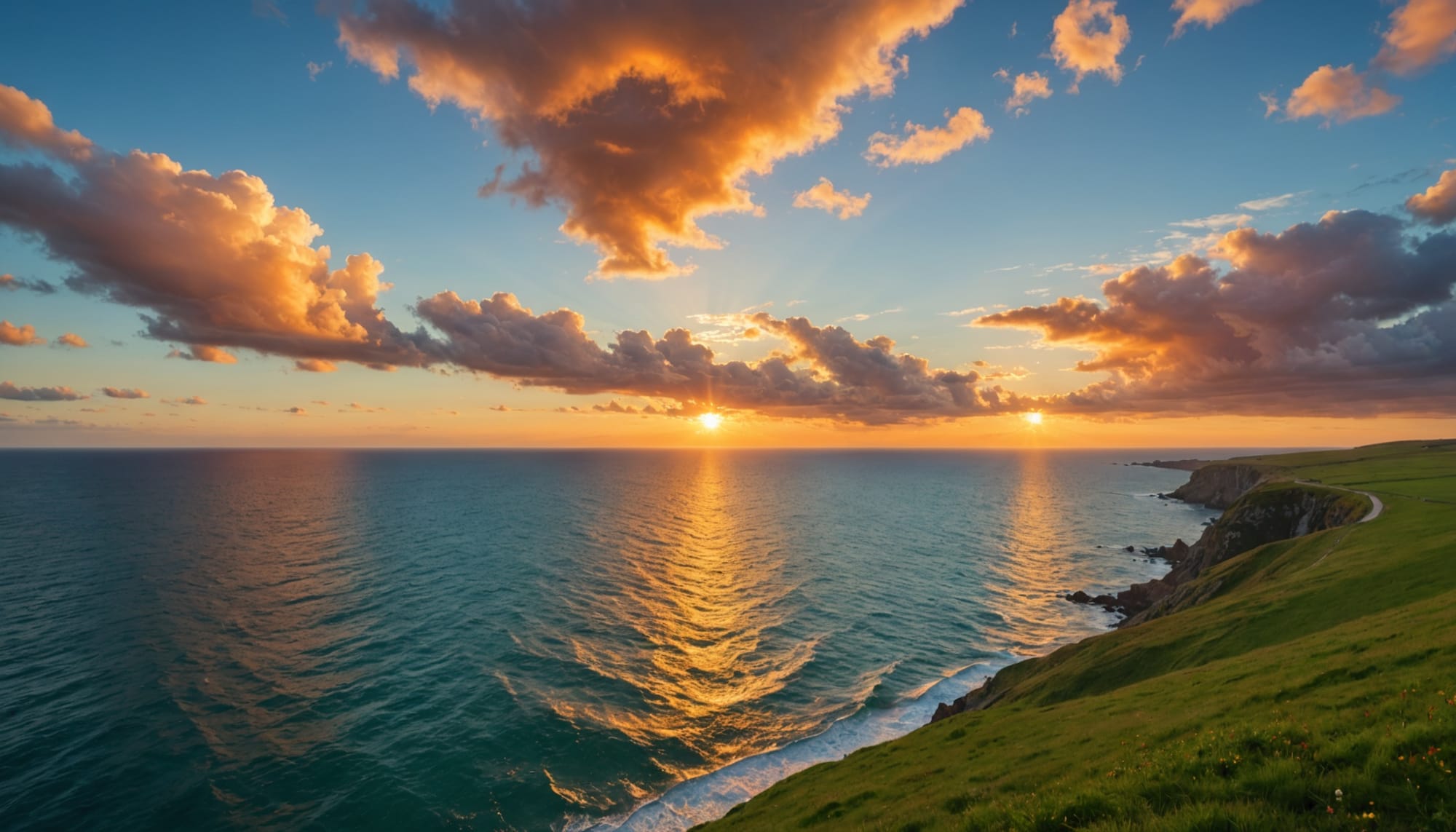
Here's something that should bother you more than it does: the same sun, the same atmosphere, the same you — and yet the sky can't decide if it wants to be blue or red. It picks both, depending on the hour. That's not a contradiction. That's a clue.
Sunlight looks white, but it's secretly every color at once. When it hits our atmosphere, it slams into tiny molecules of nitrogen and oxygen. And here's where things get interesting. Those molecules are much better at scattering short wavelengths — blues and violets — than long ones like reds and oranges. This is called Rayleigh scattering, named after the Victorian physicist Lord Rayleigh, who worked it out in the 1870s with math that still holds up perfectly.
At noon, sunlight takes the shortest possible path through the atmosphere — straight down. It only has to push through a relatively thin slice of air. The blue wavelengths get scattered in every direction, bouncing around the sky like pinballs. You look up, and blue light is coming at you from everywhere. That's your blue sky. It's not the sky that's blue. It's the light that got lost on the way down.
Now wait. Violet has an even shorter wavelength than blue. Shouldn't the sky be violet? Technically, yes. But our eyes are less sensitive to violet, and a lot of it gets absorbed in the upper atmosphere. So blue wins by default. The sky's color is partly physics, partly the quirks of human vision. Nature proposes; your retinas dispose.
At sunset, the geometry flips. The sun sits near the horizon, and its light now travels through vastly more atmosphere — sometimes 30 times as much as at noon. That's a gauntlet. All those blue wavelengths that made your afternoon sky so pretty? They get scattered away long before the light reaches your eyes. What survives the journey? The long, stubborn wavelengths. The reds. The oranges. The deep golds.
It's the same light, the same scattering, the same air. The only thing that changed is how much air the light had to fight through. A blue sky is what happens when blue gets scattered toward you. A red sunset is what happens when blue gets scattered away from you. Two sides of the same coin, spinning all day.
Dust and pollution can intensify sunsets, which is why some of the most spectacular ones follow volcanic eruptions or wildfire seasons. Krakatoa's 1883 eruption produced sunsets so vivid that people across the globe called the fire department. The sky was doing exactly what it always does — just with more particles to work with.
There's something quietly wonderful about this. Every sunset is proof that you're watching light that refused to be stopped. It crossed 93 million miles of space, hit a wall of air, lost its blues, and still showed up — just wearing different clothes.
Next time someone tells you the sky is blue, you might ask them: blue for whom, and from where?