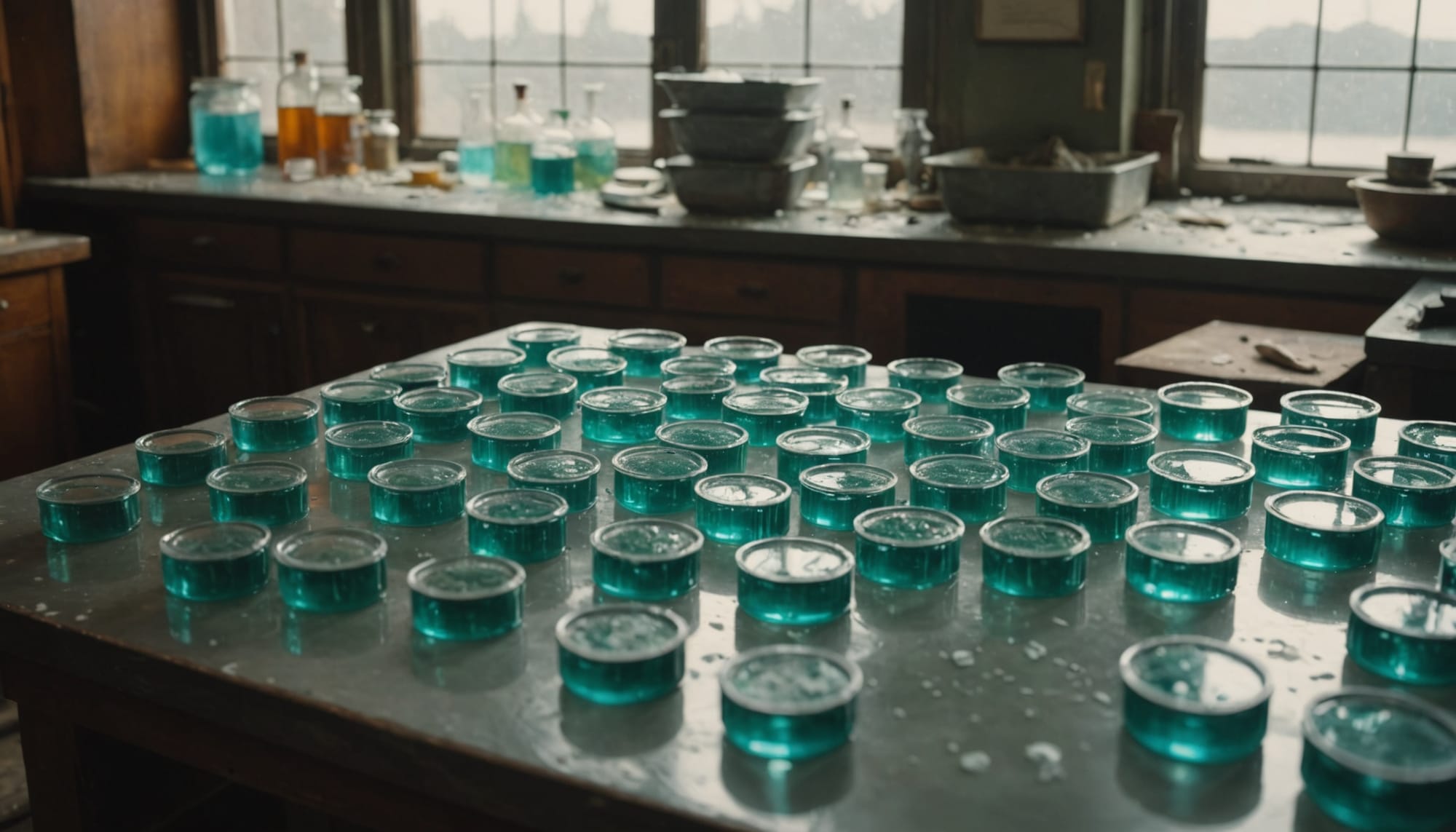
In September 1928, Alexander Fleming came back from vacation and found a mess. This was not unusual. Fleming was, by most accounts, not a particularly tidy scientist. His lab at St. Mary's Hospital in London was famously cluttered — petri dishes stacked up, experiments half-finished, cultures left out in the open air. It drove his colleagues slightly mad.
But on this particular morning, one dirty dish changed everything.
Before leaving for holiday, Fleming had been growing colonies of Staphylococcus bacteria — nasty stuff responsible for boils, sore throats, and worse. He'd left the dishes sitting out. When he returned, he noticed something odd. A blob of mold had drifted in through an open window and landed on one of the plates. And around that mold, the bacteria were gone. Not just dying. Gone. A perfect, clear halo of nothing where the staph should have been thriving.
Most people would have tossed the contaminated dish. Fleming almost did. But something about that clean ring caught his eye. "That's funny," he reportedly said to a colleague. Not eureka. Not a shout of triumph. Just: that's funny.
The mold was Penicillium notatum, a relative of the stuff that grows on stale bread. Fleming figured out it was producing some substance that killed bacteria, and he called it penicillin. He published a paper about it. And then — here's the part people forget — almost nothing happened. For over a decade.
Fleming couldn't figure out how to produce penicillin in useful quantities or keep it stable long enough to treat patients. The grueling work of turning a moldy observation into actual medicine fell to two other scientists: Howard Florey and Ernst Boris Chain, working at Oxford in the early 1940s. They cracked the purification problem, ran the first human trials, and eventually scaled production with help from American labs. By D-Day, there was enough penicillin to treat Allied soldiers' infected wounds. It was, genuinely, a miracle.
All three men shared the Nobel Prize in 1945. But the story endures because of that first moment — the unwashed dish, the accidental spore, the scientist messy enough to leave his work out and curious enough to look twice at a ruined experiment.
Here's what gets me. Fleming's sloppiness was necessary but not sufficient. The mold had to land on exactly the right plate. The temperature in London that week had to be cool enough for the Penicillium to grow before the bacteria overwhelmed it. A slightly warmer September, a slightly tidier lab, and the whole thing never happens.
We like to imagine discovery as a flash of genius. Sometimes it's a flash of mold. The real skill isn't in the accident — it's in noticing that the accident is interesting.
What are you walking past every day that's trying to tell you something funny?