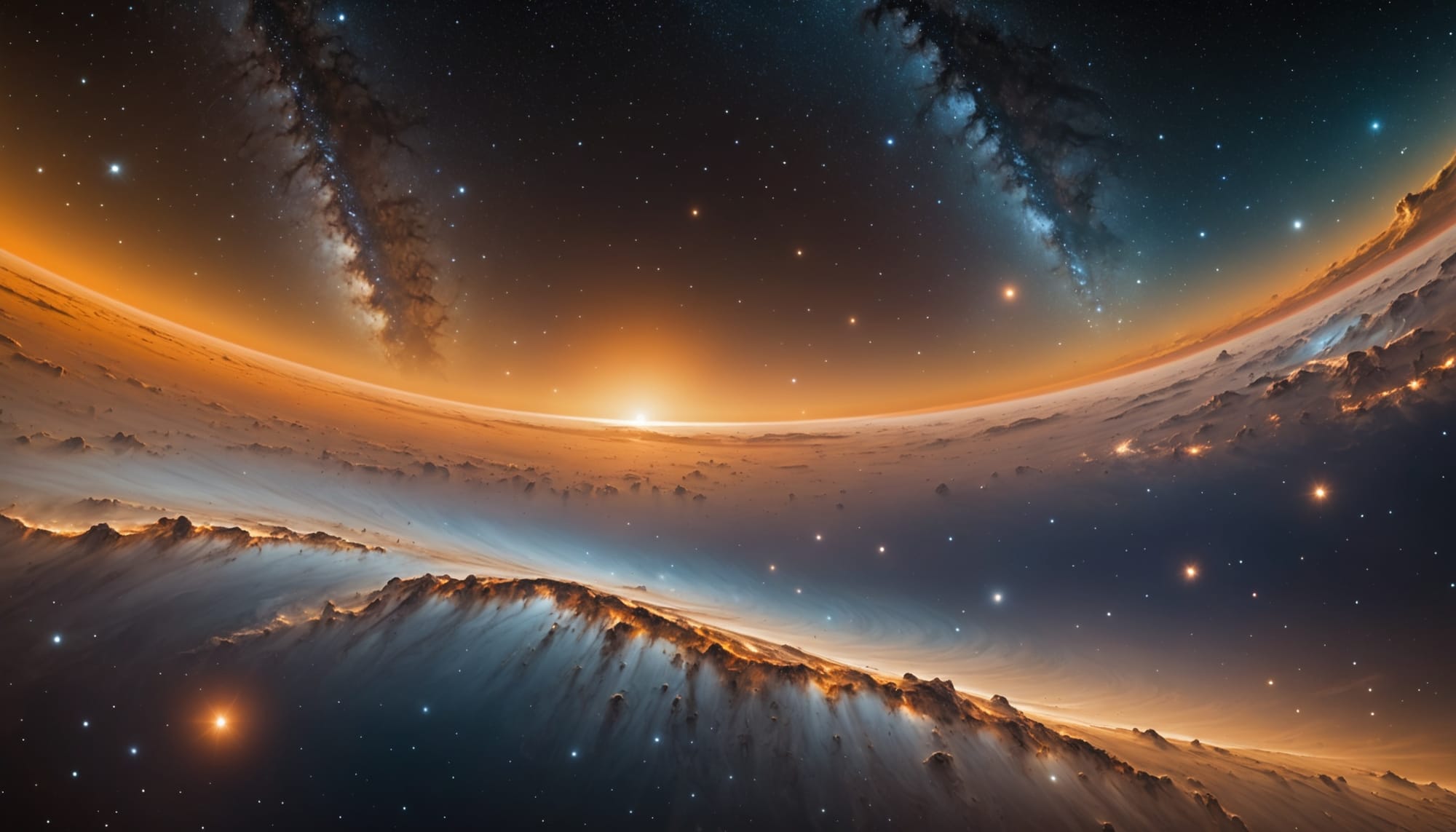
The entire universe used to glow. Not the way a sunset glows, not poetically. Literally. Every point in space was a single, blazing color — and that color was orange.
Let's back up. About 380,000 years after the Big Bang, something remarkable happened. The universe had cooled just enough for atoms to form, which meant light could finally travel freely without slamming into a fog of loose electrons. Physicists call this moment "recombination," which is a terrible name because nothing was recombining — it was combining for the first time. But never mind.
At that moment, the universe was roughly 3,000 Kelvin — about the temperature of a dim orange star. So the light released in every direction was a warm, fiery orange-white. Imagine standing in a room where the walls, the floor, the ceiling, and the air itself all glowed the same soft tangerine. No shadows. No contrast. Just light, everywhere, the same temperature as a candle flame.
But the universe kept expanding. And as it expanded, that light stretched. Wavelengths got longer. Orange slid toward red, red toward infrared, and eventually far beyond what any eye could see. Today, that ancient glow still fills all of space — we call it the Cosmic Microwave Background — but it's been stretched into microwaves. Invisible. The universe went dark, at least to our eyes.
Which raises a fun question: what color is the universe now?
In 2002, astronomers Karl Glazebrook and Ivan Baldry at Johns Hopkins decided to find out. They averaged the light from over 200,000 galaxies and calculated the color that a human eye would perceive if all that light were mixed together. After correcting an early error (they initially announced it was turquoise, which made headlines, then had to retract — awkward), they landed on the answer.
Beige. A slightly warm, slightly greenish off-white. They asked the internet to name it, and after sifting through suggestions like "Skyvory" and "Univeige," the winning entry was Cosmic Latte.
That's the current average color of everything. Not the deep black we imagine when we think of space. Not the blue of nebula photos. A latte. The universe, taken as a whole, looks like the inside of a coffee shop.
There's something quietly profound in this. The cosmos started as a blinding orange furnace, cooled through every shade of ember and rust, and settled into the color of a drink you'd order on a Tuesday morning. The most dramatic transformation in the history of existence, and it ended up beige.
Makes you wonder — in another few billion years, as the last red dwarf stars fade and the expansion stretches light even further, what color will the universe be then? And will anyone be around to not see it?