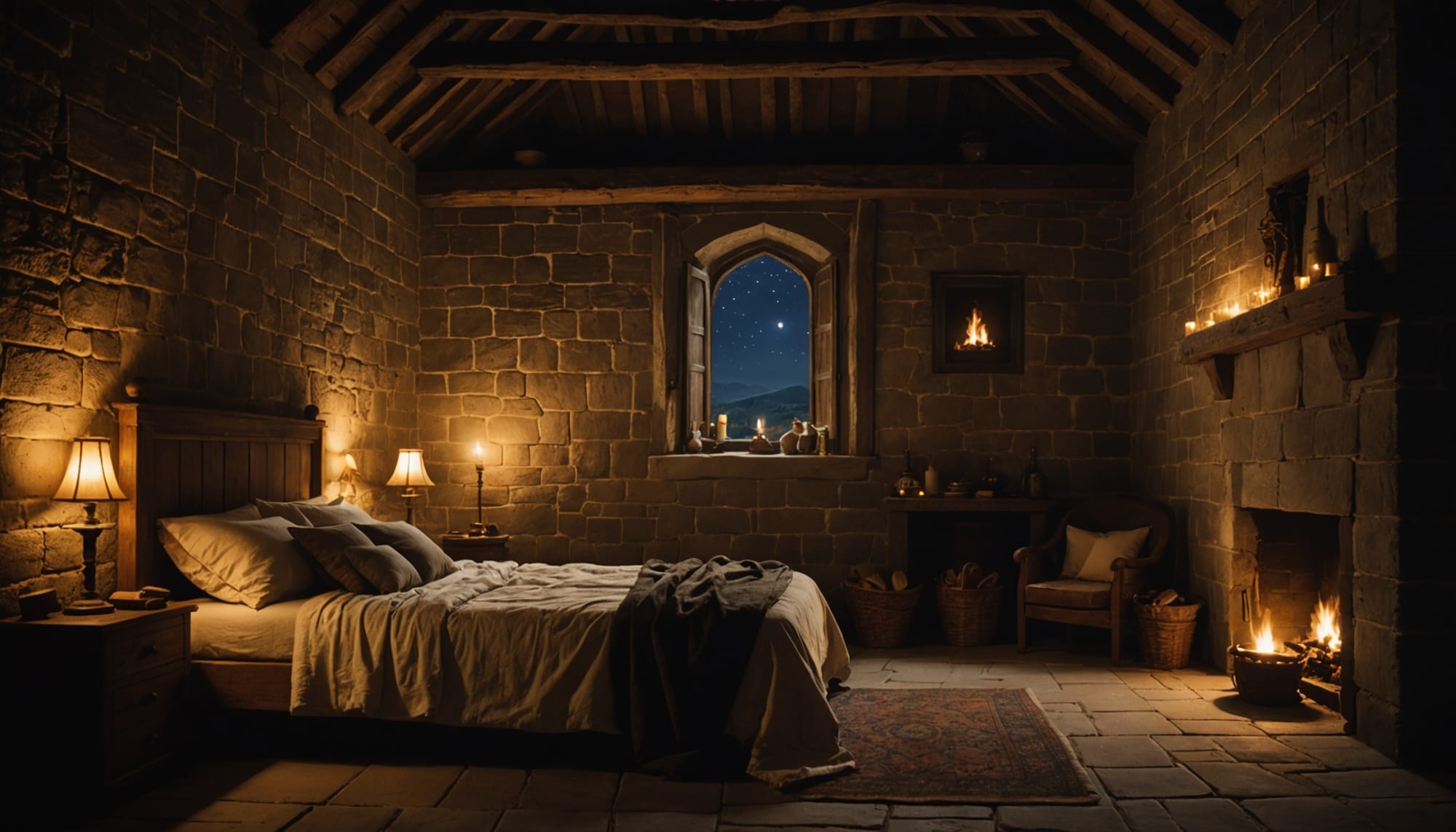
Here's something that might rearrange your relationship with your ceiling at 2 AM: for most of recorded history, humans didn't sleep in one long stretch. They slept in two.
Historians call it biphasic sleep, and it worked like this. You'd go to bed shortly after dark, sleep for about four hours, then wake up naturally sometime around midnight. You'd stay awake for an hour or two — praying, talking, having sex, tending the fire, visiting neighbors — and then drift back into a second sleep that lasted until dawn.
This wasn't a fringe practice. It was the practice. References to "first sleep" and "second sleep" appear in Chaucer, in Homer, in court documents, in medical texts, in prayer manuals. A 15th-century doctor advised that the best time for conception was after the first sleep, when couples would be rested but relaxed. The hour of wakefulness was so ordinary it barely warranted explanation — like mentioning lunch.
The historian who pieced all of this together is Roger Ekirch, a professor at Virginia Tech who spent sixteen years combing through diaries, literature, and legal depositions. He found over 500 references spanning centuries and continents. The pattern was everywhere, hiding in plain sight, in phrases people had stopped understanding.
So what killed it? Artificial light. As street lamps, coffeehouses, and eventually electric bulbs colonized the night, bedtimes drifted later. The quiet dark hours that once cushioned the two sleeps simply vanished. By the early twentieth century, most of the Western world had consolidated into the single eight-hour block we now treat as gospel. The very concept of "first sleep" disappeared from common language.
Here's the fascinating part. In the 1990s, psychiatrist Thomas Wehr ran an experiment. He put subjects in darkness for fourteen hours a night — roughly matching pre-industrial conditions. Within weeks, every single participant spontaneously began sleeping in two distinct four-hour phases with a calm, meditative hour of wakefulness in between. Their bodies remembered something their culture had forgotten.
During that midnight gap, Wehr found something else: elevated levels of prolactin, the same hormone associated with the peaceful alertness of deep meditation. The subjects described feeling a kind of serene wakefulness unlike anything in their normal lives. Not insomnia. Not restlessness. Something older.
We've spent decades pathologizing middle-of-the-night wakefulness. Billions of dollars in sleep aids. Entire industries built around the assumption that waking at 2 AM means something is wrong.
But maybe your body isn't broken. Maybe it's just trying to give you back something the lightbulb stole.
What would you even do with a quiet, expectation-free hour in the dead of night?