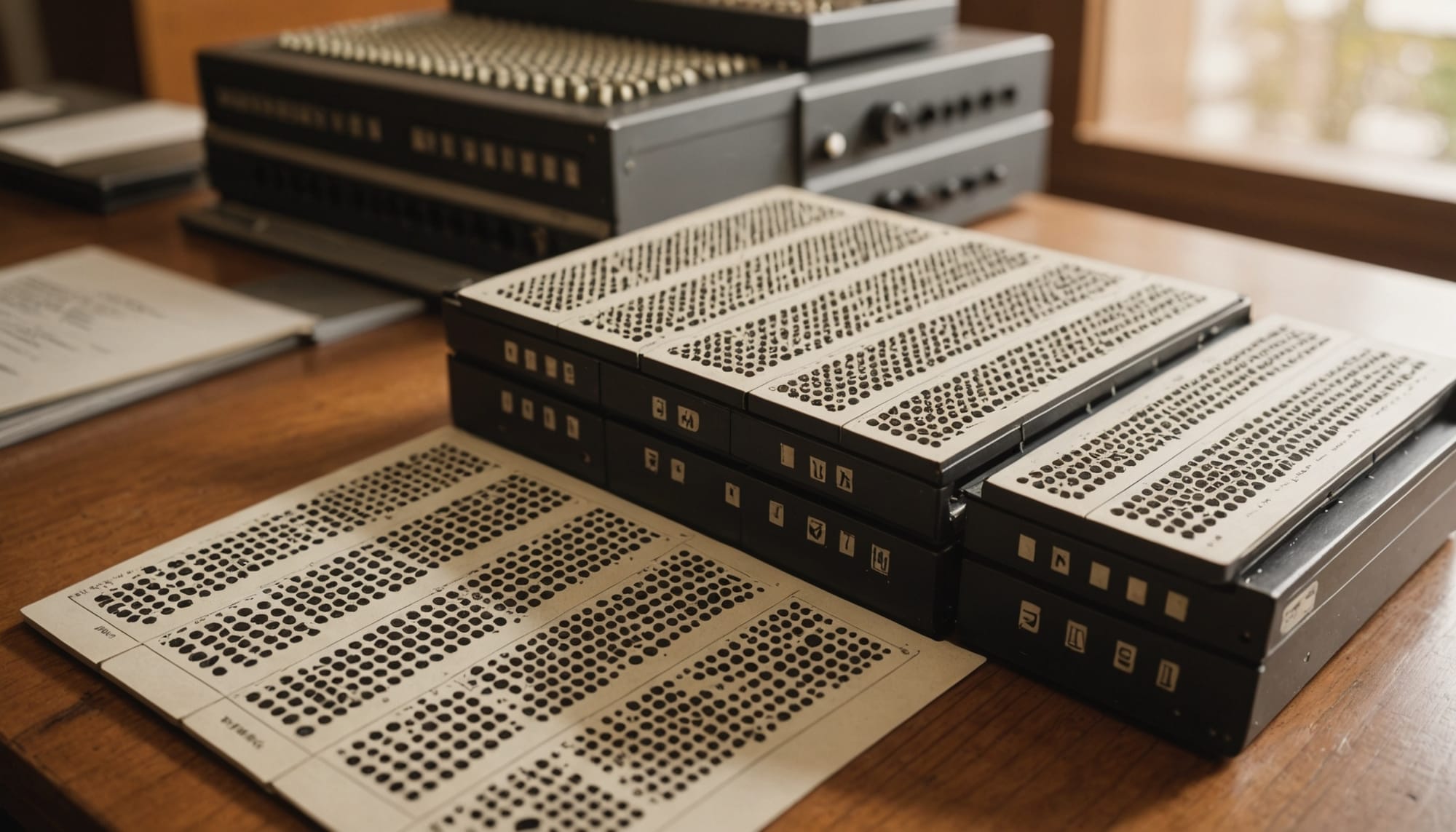
Here's a question that sounds obvious until you actually think about it: why did early computers use punch cards? Stiff little rectangles with holes in them. Fiddly, fragile, easy to drop. Surely someone could have come up with something better.
They probably could have. But that's not how technology works. Technology doesn't choose the best solution. It chooses the solution that's already lying around.
The punch card story starts not with computers but with a crisis. The 1880 U.S. Census took eight years to tabulate by hand. Eight years. The country was growing so fast that by the time the results were done, they were nearly obsolete. Officials realized with some horror that the 1890 census might not be finished before the 1900 census began.
Enter Herman Hollerith, a young engineer with a beautifully lateral idea. He'd seen train conductors punch tickets in specific positions to record a passenger's description — hair color, eye color, build. What if you could punch holes in a card to represent census data, then run the cards through a machine that used electrical contacts to read the holes and count them automatically?
It worked spectacularly. The 1890 census was tabulated in about one year. Hollerith became famous. He founded a company. That company eventually merged with others to become — you guessed it — IBM. International Business Machines.
And IBM made punch cards for everything. Payroll. Inventory. Accounting. For decades before electronic computers existed, businesses ran on Hollerith-style cards. Warehouses full of them. Whole industries built around manufacturing, printing, and storing them. By the time programmable computers arrived in the 1940s and 50s, punch cards weren't just familiar. They were infrastructure.
The machines to punch them existed. The machines to read them existed. The suppliers existed. The workforce knew how to use them. Choosing punch cards for early computers wasn't a technical decision. It was an economic one. Why build an entirely new input system when millions of card readers were already humming away in offices worldwide?
This is a pattern that repeats everywhere in technology. We call it path dependence — the idea that early choices constrain later ones, even when better alternatives emerge. The QWERTY keyboard. Railroad gauge widths. USB-A before USB-C. Once an ecosystem grows around a standard, switching costs become enormous, and "good enough plus already everywhere" beats "better but starting from scratch" almost every time.
Punch cards hung on in computing until the 1970s and 80s. That's nearly a century of dominance, all because a census was taking too long.
It makes you wonder: what are we using right now — clicking, swiping, typing — not because it's the best way, but simply because it was already here when we needed something?