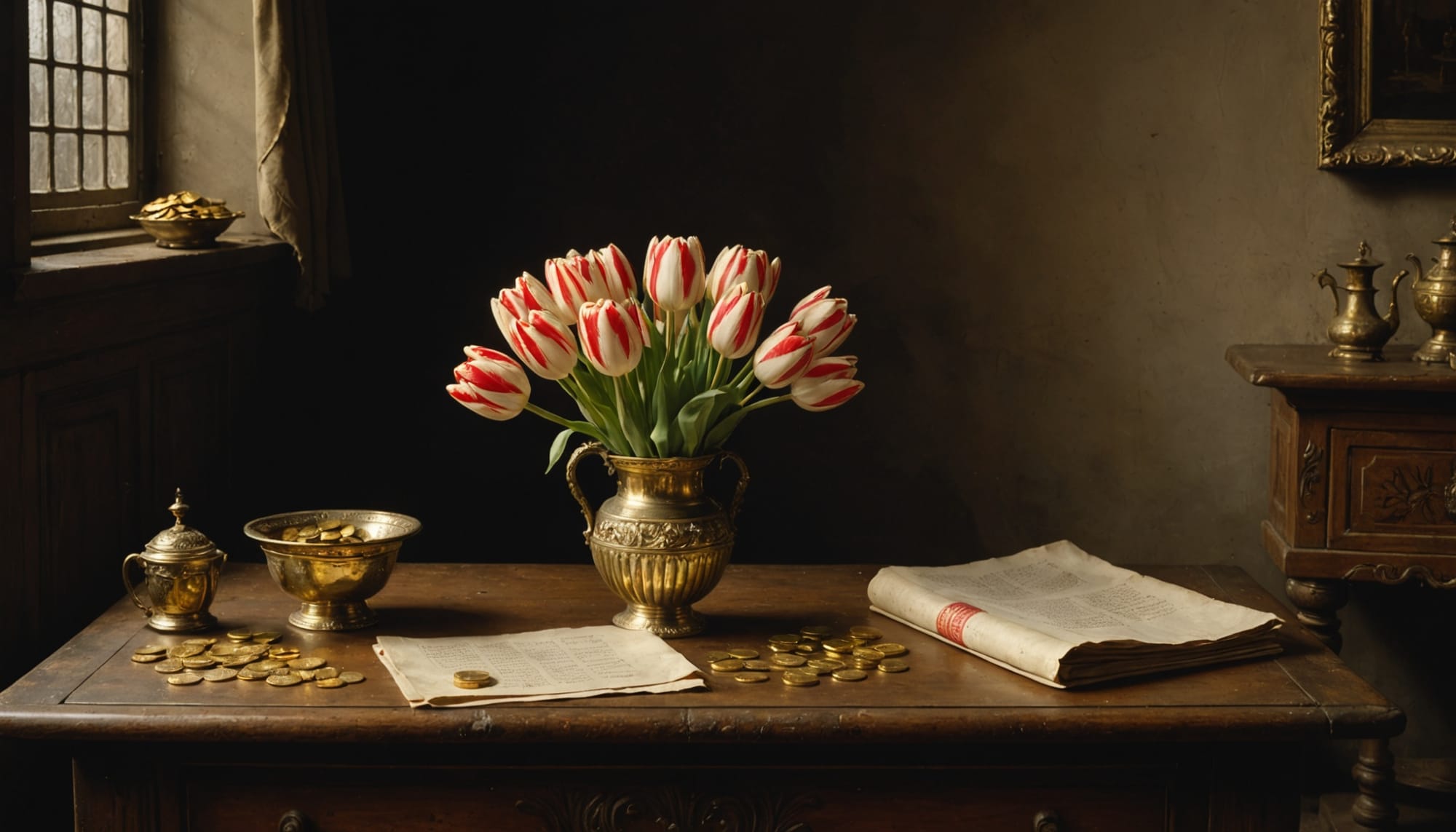
In February 1637, a tulip bulb called the Semper Augustus sold for 10,000 guilders. A nice house on the Amsterdam canal cost about 5,000. So yes — a single bulb, sitting in the dirt, was worth two houses. This actually happened.
But here's the thing people get wrong about tulip mania. It wasn't mass stupidity. It was mass logic — applied to a fundamentally absurd situation.
The Dutch Republic in the 1630s was the richest nation on Earth. Money was sloshing around. Merchants who'd made fortunes in spice and shipping needed somewhere to put their wealth, and tulips had a few qualities that made them surprisingly good candidates.
First, they were genuinely rare. The most prized varieties — the ones with flaming streaks of color on their petals — couldn't be reliably reproduced. (We now know those streaks were caused by a virus. The flowers were literally sick. The most valuable tulips in history were diseased.) A grower might wait years for a single bulb to produce offsets. Scarcity was real.
Second, tulips were portable, storable, and verifiable. You could examine a bulb. You could weigh it. It felt like a solid thing to trade. More solid, frankly, than a lot of the paper financial instruments floating around Amsterdam's brand-new stock exchange.
Third — and this is where it gets interesting — people stopped trading actual tulips. The market shifted to futures contracts. You weren't buying a bulb. You were buying a piece of paper that said someone would deliver a bulb to you in the spring. Which meant you could trade that paper all winter long without anyone ever touching a flower. The bulbs were still in the ground. The money was entirely in the air.
At the peak, traders were meeting in taverns, drinking, and flipping contracts the way people flip meme stocks today. Some of them had never seen a tulip garden in their lives. They didn't need to. They were trading the idea of tulips.
Then one day in Haarlem, a routine auction found no buyers. The price didn't dip. It evaporated. Within weeks, contracts worth thousands of guilders were worth less than the paper they were printed on. The crash was so sudden that the Dutch government essentially threw up its hands and told people to sort it out amongst themselves.
What lingers about tulip mania isn't the absurdity. It's the familiarity. Every element — the genuine innovation, the speculation layered on top, the moment when trading the thing replaced wanting the thing — repeats with eerie precision every few decades. Railroads, dot-coms, housing, crypto. The flower changes. The fever doesn't.
The Semper Augustus was beautiful, by the way. White petals with deep crimson flames. People described it as breathtaking.
It just wasn't worth two houses. But then again — how do you price something everyone wants and no one needs?