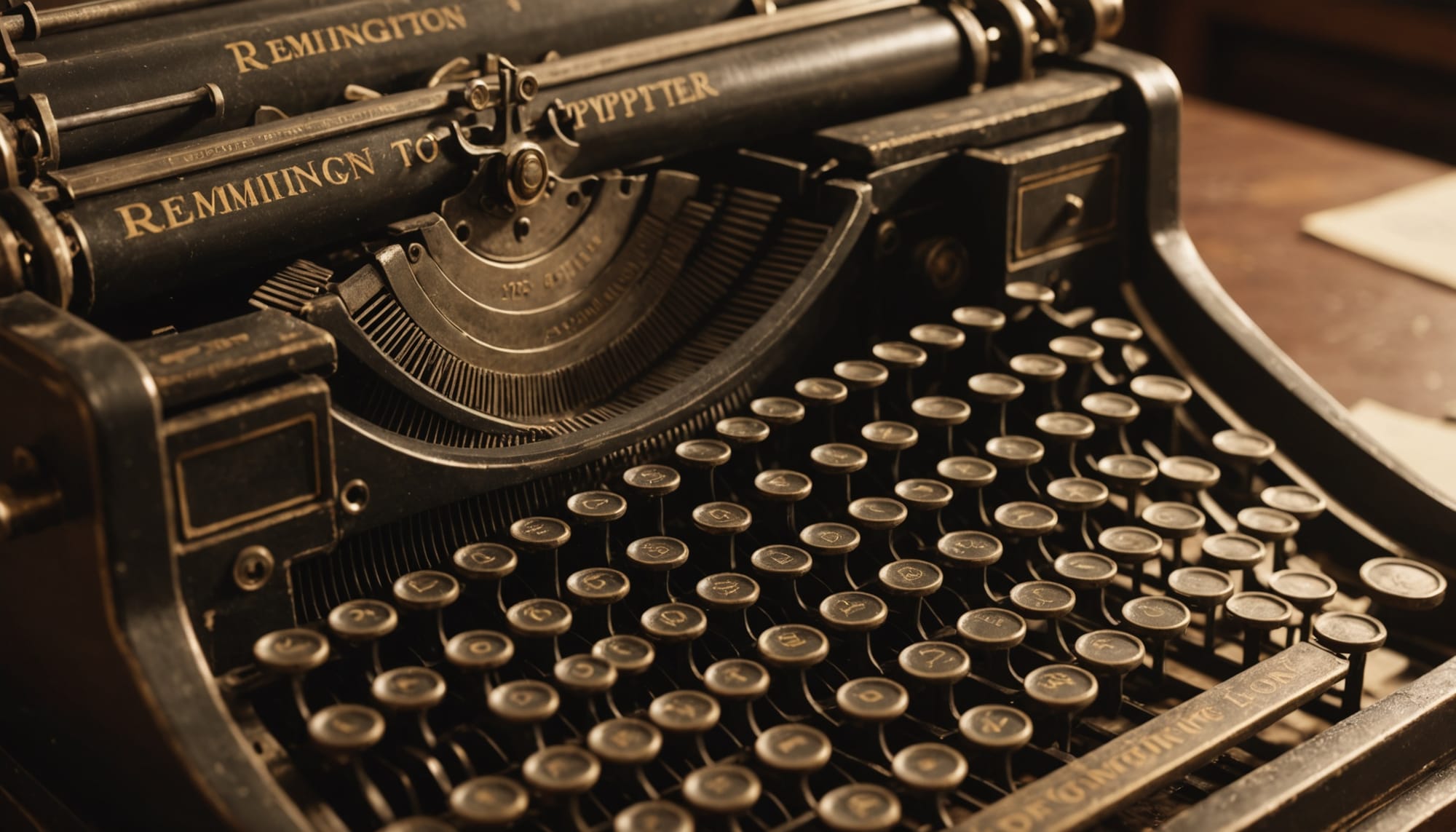
Look down at your keyboard. Or your phone. That familiar jumble of letters — QWERTY across the top row — has been with you so long it feels inevitable. Like it was always this way. Like someone sat down and figured out the best arrangement of 26 letters.
They didn't. Not even close.
In 1873, Christopher Latham Sholes was struggling with a very specific mechanical problem. His early typewriters used metal typebars that swung upward to strike an inked ribbon. Type too fast, and neighboring bars would collide and jam. The machine would seize up like a fistful of tangled coat hangers.
So Sholes didn't ask, "Where should letters go for maximum typing speed?" He asked something much more practical: "How do I keep the most common letter pairs apart from each other?" He studied English letter frequency — which pairs show up together most often — and deliberately separated them. The goal was to make the typebars swing from different angles, reducing collisions.
It worked beautifully. The Remington company licensed the layout in 1874, shipped it on their first commercial typewriter, and the rest is path dependency.
Here's where it gets interesting. By the 1930s, typebar jams were essentially a solved problem. Electric typewriters eliminated them entirely. And yet QWERTY persisted. In 1936, August Dvorak patented a keyboard layout specifically optimized for speed and comfort. Studies suggested it was faster. Ergonomists loved it. The U.S. Navy even ran trials that seemed to confirm its superiority.
Nobody switched.
This is the part that should make you tilt your head. We kept the slower layout. Not because it was better. Not because Dvorak was flawed (though later studies muddied the speed claims). We kept it because everyone already knew QWERTY. Every typist, every typing class, every office, every manufacturer. Switching would mean retraining the entire world.
Economists have a name for this: a switching cost so large it makes an inferior standard permanent. It's the same reason we still measure things in feet and miles in certain countries, and why USB cables took forever to become reversible even though everyone hated them.
There's a deeper strangeness here, though. Some historians now argue Sholes wasn't only trying to prevent jams — he may have also been influenced by telegraph operators who needed certain letters accessible. The origin story, like most origin stories, is messier than the myth.
But the core truth holds. You are typing on a layout designed around the physical limitations of a machine that no longer exists. Your muscle memory is shaped by metal arms that haven't swung in decades.
Every day, billions of people move their fingers across a solution to a 150-year-old problem they've never encountered. If that's not a perfect metaphor for how humans relate to tradition, what is?