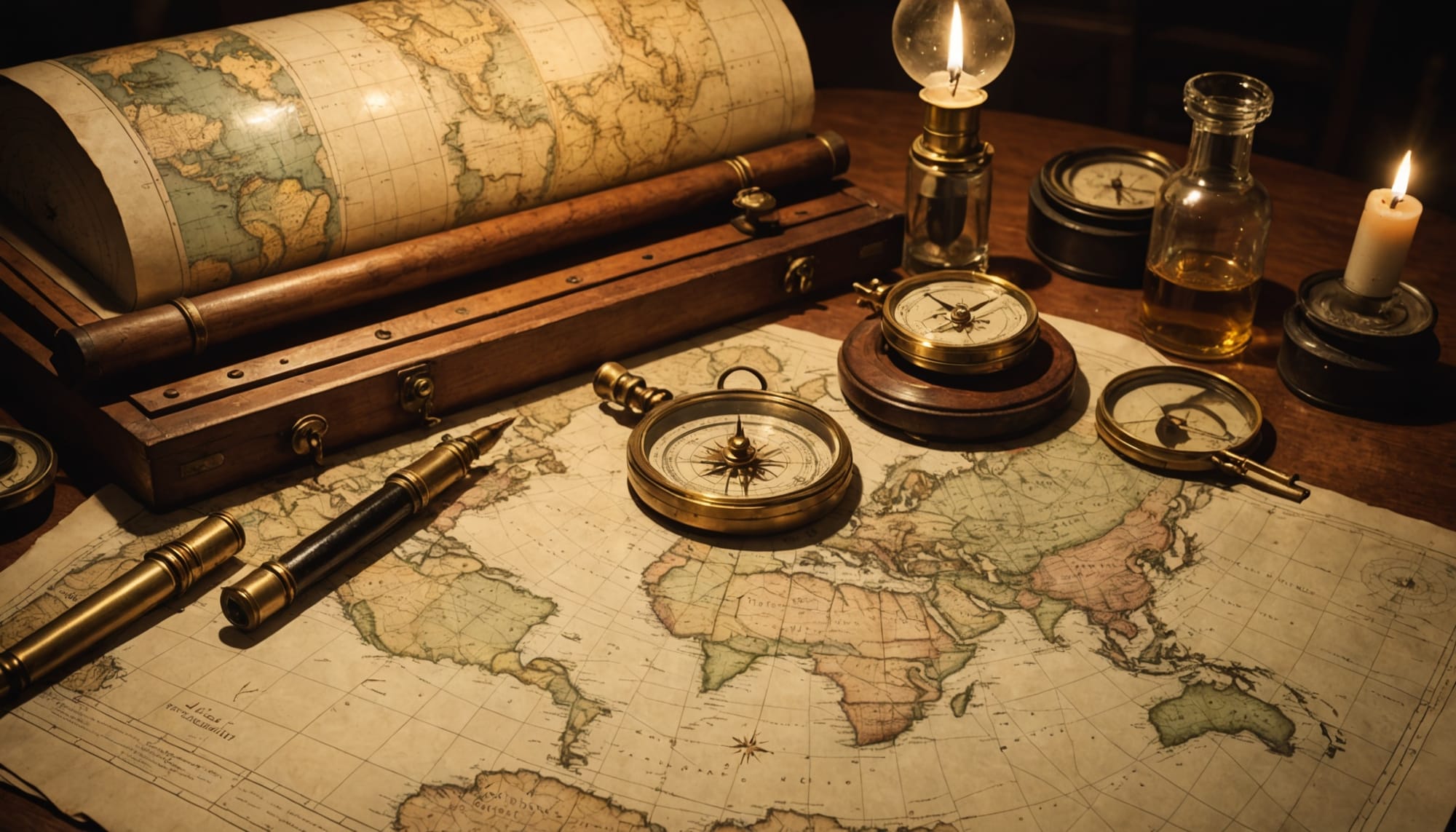
Here's a fact that should bother you more than it does: Greenland is not the size of Africa. It's not even close. Africa is fourteen times larger. But if you grew up with a classroom map on the wall — and you did — some part of your brain still doesn't quite believe that.
You can thank Gerardus Mercator for this. In 1569, he created the projection that would become the default image of our planet for centuries. His goal was practical: he wanted sailors to draw straight lines on maps and have those lines correspond to real compass bearings. It worked beautifully for navigation. It also made Europe and North America look enormous, and made equatorial regions — home to most of the world's population and landmass — look modest by comparison.
Mercator knew this. He wasn't confused. He made a trade-off. Every flat map of a round planet must distort something. You can preserve shapes or sizes, angles or distances. Never all of them. It's mathematically impossible. The moment you peel a sphere and press it flat, you're choosing which lie to tell.
And that choice has never been neutral.
The Peters projection, introduced in 1973, tried to correct for size. It shows land areas accurately. Africa looks massive because Africa is massive. But the shapes are stretched and squished — continents look like pulled taffy. It's honest in one dimension and grotesque in another. Cartographers mostly hated it. The public was fascinated.
Then there are the lies that aren't about math at all. For centuries, mapmakers placed their own country at the center of the world. China's name for itself — 中国, Zhōngguó — literally means "Middle Kingdom." Medieval European maps put Jerusalem at the center, with east at the top (which is why we say we "orient" ourselves — orient, as in the direction of the Orient, the East). Australian maps that flip south to the top aren't wrong. They're just making a different, equally arbitrary choice.
Some maps lied on purpose. During the Cold War, the Soviet Union systematically falsified its official maps — shifting rivers, moving streets, erasing entire towns. It was cartographic disinformation, designed to confuse any foreign power holding a captured map. Meanwhile, British mapmakers hid tiny fictional streets in their maps as copyright traps. If a competitor's map included "Lye Close" in Bristol, you knew they'd been copying.
We forgive all of this. We prefer it. A perfectly accurate representation of Earth already exists — it's called a globe. But globes don't fold into your pocket. They don't fit on a classroom wall. They're terrible for planning a road trip. We don't actually want the truth from our maps. We want a useful story.
That's the quiet deal we've struck with cartography for five hundred years. Show us something close enough. Make it flat. Make it legible. And we'll agree not to notice what you left out.
What other tools do we trust precisely because they simplify the world beyond recognition?