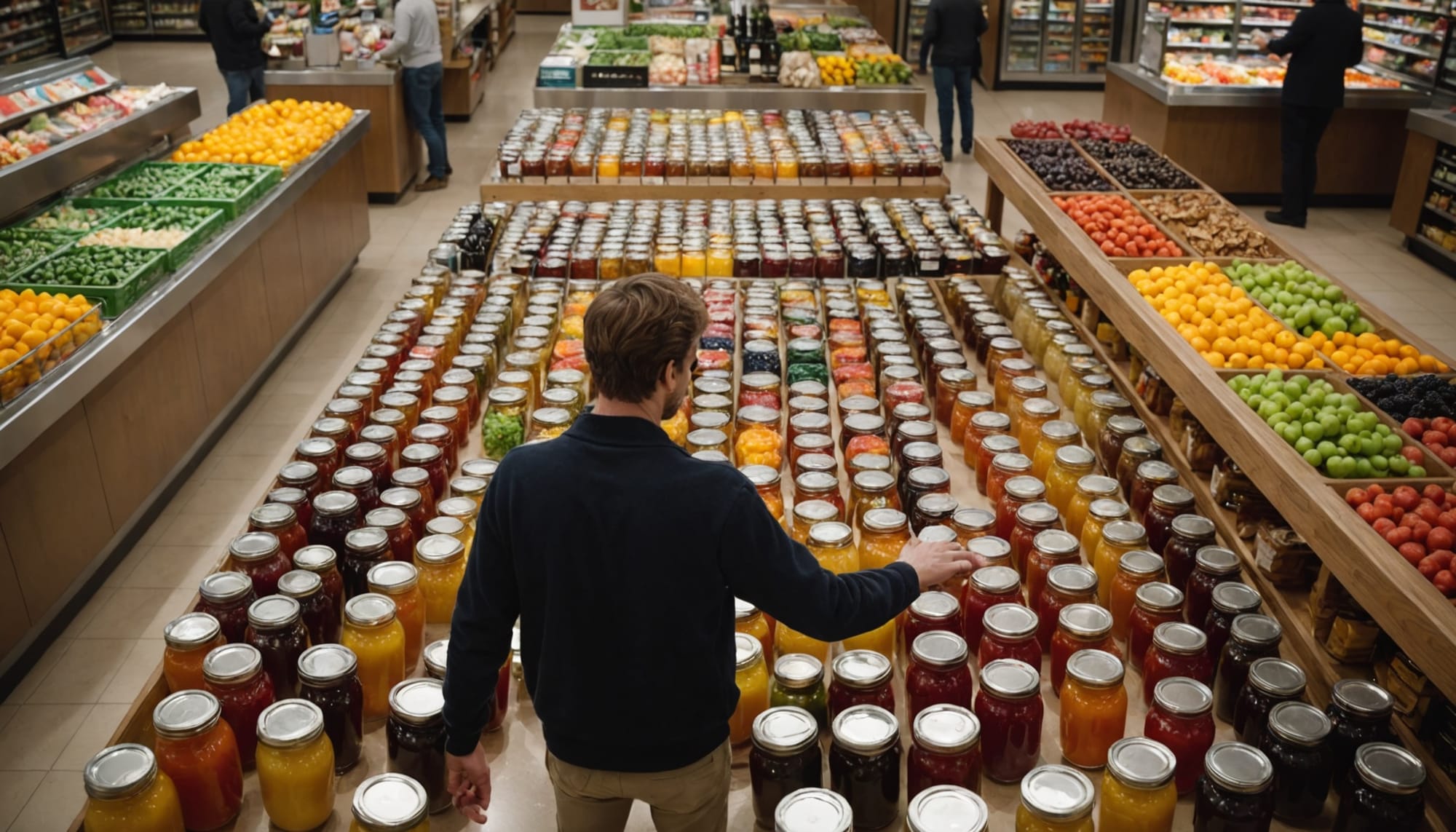
In 2000, two psychologists set up a table in an upscale grocery store in Menlo Park, California. On some days, they displayed 24 varieties of jam. On others, just 6. The results broke a fundamental assumption about commerce.
The big display attracted more people. Of course it did — it was a spectacle of strawberry-rhubarb and lemon curd and black cherry. Sixty percent of passersby stopped. The small display? Only 40 percent paused.
But here's the twist. Of the people who saw 24 jams, only 3 percent bought one. Of those who saw 6 jams, 30 percent bought one. Ten times the conversion rate. Fewer options, dramatically more purchases.
Sheena Iyengar and Mark Lepper called this the "paradox of choice," and it's become one of the most cited findings in behavioral economics. The idea is deceptively simple: at some point, more options stop feeling like freedom and start feeling like a burden.
Why? Because choosing has a cost. Every option you evaluate is a tiny act of imagination — you project yourself into a future where you picked that one. With 6 jams, that's manageable. With 24, your brain quietly rebels. It does the math on all possible regrets and decides the safest move is no move at all.
Psychologists call this "choice overload," and it shows up everywhere. Retirement plans with more fund options get lower enrollment rates. Online stores with sprawling catalogs often convert worse than curated ones. Restaurants with enormous menus make diners less satisfied with what they order. The ghost of the unchosen haunts the meal.
There's something almost poetic about it. We think we want maximum freedom. We tell researchers we prefer more options. But our behavior tells a different story. Abundance doesn't liberate us — it pins us in place, like a deer staring at 24 headlights.
The smartest companies figured this out. Apple launches a handful of phones, not forty. Trader Joe's stocks roughly 4,000 products compared to a typical supermarket's 30,000 — and its sales per square foot crush the industry. Constraints, it turns out, are a service you provide to your customers.
This doesn't mean fewer is always better. Context matters. Experts want more options; novices want fewer. High-stakes decisions benefit from breadth; low-stakes ones benefit from curation. The trick isn't minimalism for its own sake — it's understanding when choice is a gift and when it's a tax.
Next time you spend twenty minutes scrolling Netflix and then give up and rewatch The Office, you're not being lazy. You're being perfectly, predictably human. The question worth sitting with: in a world that keeps giving us more of everything, who's actually helping us choose less?