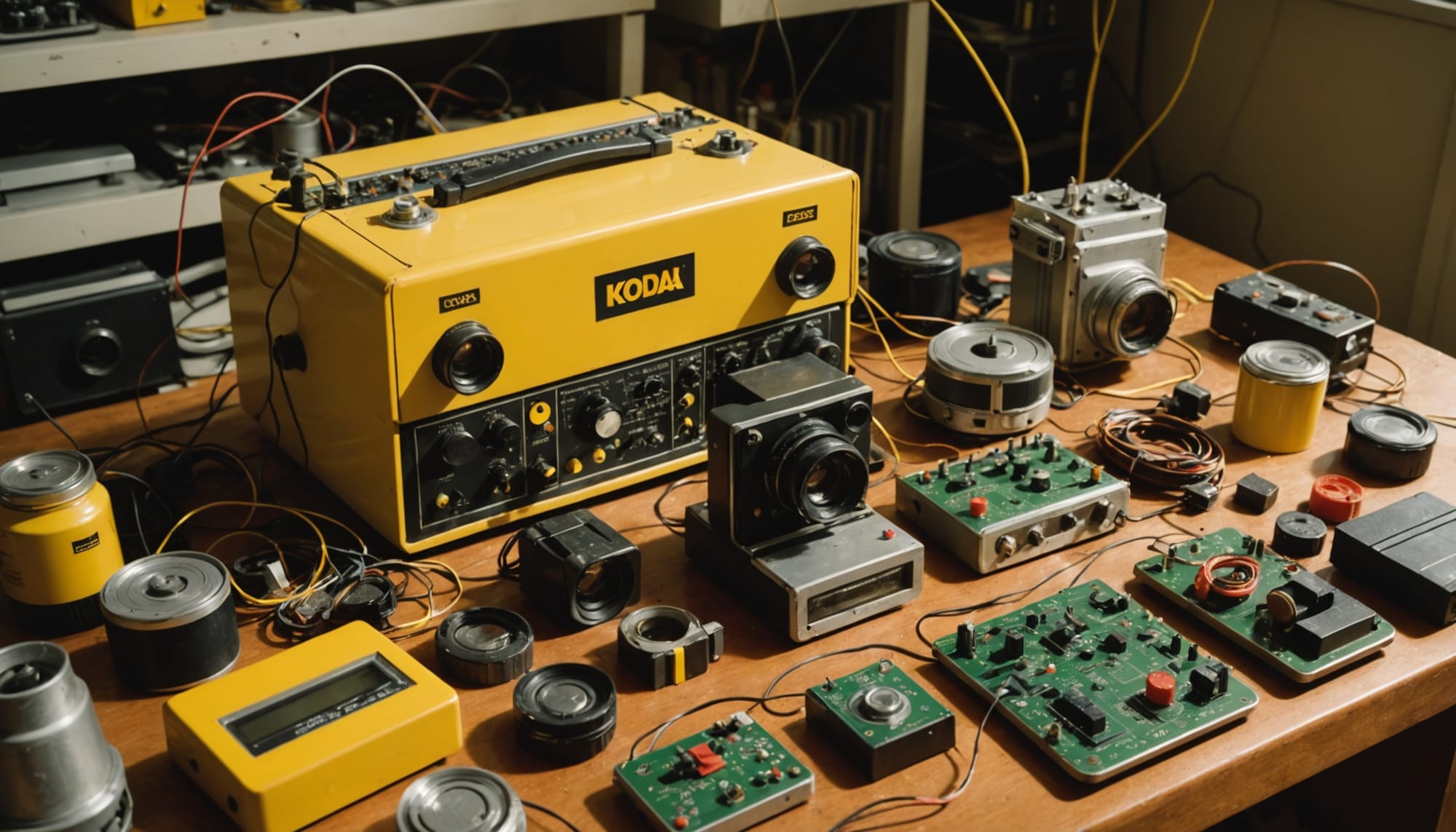
In December 1975, a 24-year-old Kodak engineer named Steve Sasson pointed a toaster-sized contraption at a lab technician and captured an image. It was 0.01 megapixels. Black and white. Took 23 seconds to record onto a cassette tape. It was, by every measure, terrible.
It was also the first digital photograph ever taken.
Sasson brought his invention to Kodak's executives. He showed them the future — a world where photographs didn't need film, didn't need chemicals, didn't need paper. The response, as Sasson later recalled, was polite but unmistakable: That's cute, Steve. But don't tell anyone about it.
You have to understand what Kodak was in 1975. They owned roughly 90% of the film market in the United States. Their margins on film were extraordinary — somewhere around 70 cents of profit on every dollar of film sold. The entire company was a machine designed to sell tiny rolls of chemistry. And here was a young engineer suggesting that chemistry was optional.
So they buried it. Not maliciously, exactly. More like reflexively. The way an animal covers something it doesn't want other animals to find.
Here's where it gets almost poetic. Kodak didn't just invent the digital camera and walk away. They kept innovating in digital photography for decades. They held some of the earliest and most important patents. They built some of the first consumer digital cameras in the 1990s. They knew, in their bones, what was coming.
But knowing and acting are different animals entirely.
Every time Kodak's digital division pushed to go bigger, the film division pushed back harder. The profits were too good. The infrastructure was too vast. They had factories, supply chains, retail partnerships — an empire built on silver halide crystals. You don't abandon an empire because someone in the lab has a hunch about the future.
Except sometimes you should.
By the time Kodak finally committed to digital in the early 2000s, the window had closed. Canon, Sony, and Nikon had eaten the market. In January 2012, Kodak filed for bankruptcy. The company that literally invented digital photography had been destroyed by digital photography.
Business school professors call this the "innovator's dilemma" — the trap where your current success becomes the very thing that prevents you from embracing the next success. It sounds academic until you watch it happen. Then it sounds like a Greek tragedy.
Sasson, for his part, received the National Medal of Technology and Innovation in 2009. He seems to hold no grudges. He was an engineer. He built a thing. What the company did with it was the company's problem.
But I keep thinking about that moment in 1975. A young guy holding a box of circuits and wires, showing a roomful of executives exactly what's going to happen. And the executives, very reasonably, very rationally, choosing not to see it.
How many futures are sitting in drawers right now, waiting for someone brave enough to open them?