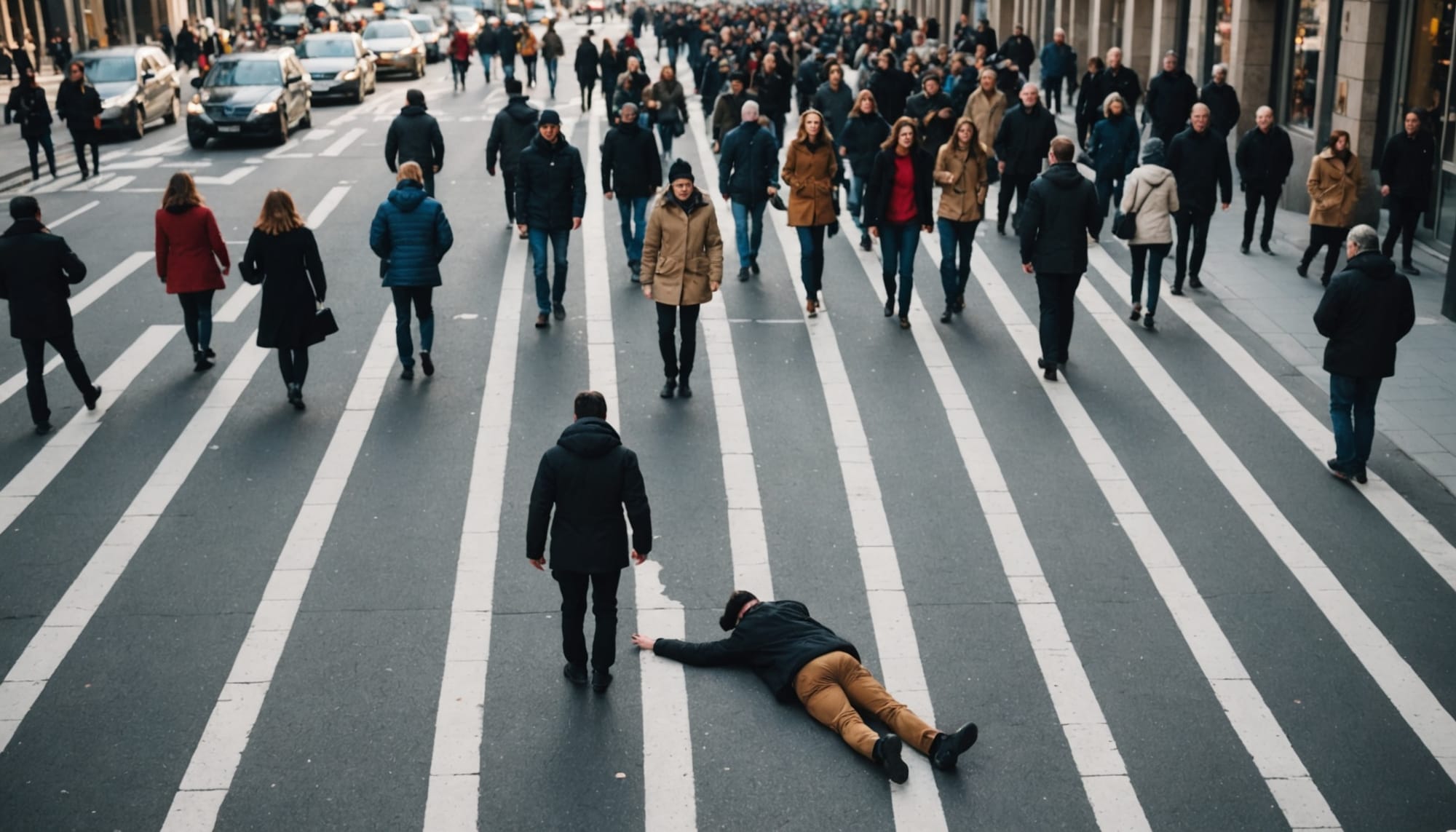
Here's a morbid little thought experiment. You collapse on the street. Do you want one person nearby, or fifty?
Your gut says fifty. More people, more chances someone helps. It's simple math. Except it isn't. Because humans aren't calculators. We're herd animals wearing shoes.
In 1968, psychologists John Darley and Bibb Latané ran an experiment that still haunts introductory psych courses. They had participants sit in individual booths, believing they were in a group discussion over an intercom. One voice — actually a recording — began having what sounded like a seizure. When participants thought they were the only other person listening, 85% rushed to help. When they thought four others were also listening? That number plummeted to 31%.
Same emergency. Same sounds of distress. The only thing that changed was the imagined size of the audience.
Darley and Latané called it the bystander effect, and they identified the engine driving it: diffusion of responsibility. When you're the only witness, the moral weight lands squarely on you. There's no ambiguity. But add more people and that weight gets divided like a restaurant check nobody wants to calculate. Surely someone else will handle it. Someone closer. Someone more qualified. Someone who isn't running late.
There's a second force at work too — pluralistic ignorance. In ambiguous situations, we look to others for cues on how to react. If nobody else seems alarmed, we assume everything must be fine. Everyone's scanning everyone else's calm face and collectively deciding that the person slumped on the bench is probably just tired. It's a feedback loop of inaction, each person's passivity confirming the next person's hesitation.
The classic case that inspired Darley and Latané's research was the 1964 murder of Kitty Genovese in New York. The original newspaper report claimed 38 witnesses watched or listened and did nothing. Later investigations revealed that account was significantly exaggerated — some did call police, and most couldn't clearly see what was happening. But the flawed story sparked real science, and the science held up. The effect is robust. It's been replicated across cultures, age groups, and settings, from lab rooms to city streets.
Here's what's oddly hopeful, though. Simply knowing about the bystander effect seems to weaken it. Studies suggest that people who've learned about diffusion of responsibility are more likely to intervene in emergencies. Awareness acts like a vaccine. Once you understand the trap, you're less likely to fall into it.
And if you're ever the one who needs help? Emergency responders teach a brutally effective trick: don't yell "somebody help me." Point at one specific person. "You, in the blue jacket — call 911." Collapse the crowd back into an individual. Reverse the math.
Fifty witnesses and zero helpers. One witness and one hero. Turns out the most dangerous thing about a crowd isn't what it does — it's what it quietly decides not to do.